
Your inbox isn't a to-do list, it's a source of anxiety#
Over 80 percent of workers feel anxious about work email, and more than half feel that way regularly. That figure comes from research cited by EmailTooltester, and it lines up with what psychologists call open loops. Every unread message sits in your working memory as an unfinished task, quietly draining attention even when you are not looking at your inbox. Once daily unread volume passes about 50 messages, that low-grade anxiety reliably tips into something that measurably slows down decision-making. Researchers call the fallout attention residue, and longitudinal studies published in PMC link sustained high email load to increased strain, independent of normal workplace pressures like deadlines and interruptions.
This is not a discipline problem. It is not that people are bad at managing their inbox. It is that every unread email, unopened PDF, and unfinished report is competing for the same small pool of attention, and most of what gets sent loses that competition by design.
The scale of the problem, in numbers#
Three separate research streams point to the same thing from different angles: attention, workplace communication, and where people's time actually goes.
Attention. Beyond the email anxiety numbers above, long-form written content in general struggles to get finished. Aggregated analytics across Chartbeat, Hotjar, and Crazy Egg studies find that only 20 to 30 percent of readers scroll far enough to reach the end of long-form content over 2,000 words. Shorter pieces do somewhat better, with 40 to 55 percent of readers making it through content under 1,500 words. The pattern holds whether it is a blog post, an internal wiki page, or a PDF: the longer and denser the document, the fewer people finish it.
Communication. Axios HQ's 2026 State of Internal Communication surveyed more than 1,200 US executives and employees and found that only 1 in 6 employees feels entirely aligned with organizational goals, even as comms volume rises while clarity falls. Leaders and employees do not even agree on the basics: 80 percent of leaders think internal communications are clear and engaging, versus only 50 percent of employees. That 30-point perception gap is the unread problem showing up in a spreadsheet.
The cost is not abstract. Earlier Axios HQ research put the cost of poor workplace communication at $3,640 to $37,440 per employee per year, depending on salary band. Grammarly's research with Harris Poll landed in a similar range: roughly $9,284 per employee per year, or $9.3 million annually per 1,000 employees. The fuller breakdown is in the real cost of unread internal communications.
Time. Even when someone wants to read something, they often do not have a spare hour. McKinsey Global Institute's benchmark study, still the most-cited figure in this space more than a decade after publication, found that knowledge workers spend close to 20 percent of the workweek, about 9.3 hours, searching for and gathering information, plus another 28 percent managing email. Gallup's 2026 State of the Global Workplace report adds the engagement angle: only 20 percent of employees worldwide were engaged in 2025, a decline Gallup ties to an estimated $10 trillion in lost global productivity. The full picture of what is competing for that attention is in information overload at work: stats and solutions.
Put these together, and the picture is simple. Attention is already spoken before your message arrives, communication volume keeps rising, and the documents caught in the middle are the ones that lose.
The decision that happens before anyone reads a word#
Something worth understanding about how documents actually fail, because it changes where you spend your effort.
Abandonment is not usually a gradual loss of interest across twelve pages. It is a decision made in the first few seconds, before any real reading has happened. A person opens a document, scans its shape, estimates what it will cost them in time and effort, and decides whether to pay. Most of what gets called "not reading" is that estimate coming back unfavourable.
This is why the visible properties of a document matter more than they should. Length, paragraph density, whether there is any structure to navigate by, whether the first line says anything specific. These are all read before the content is, and they determine whether the content gets read at all.
It also explains a common frustration. Teams often respond to poor engagement by adding more to a document: more context, more background, more thoroughness, so nobody can say they were not told. Every one of those additions makes the initial estimate worse. The more complete the document, the more reliably it gets abandoned, which is close to the opposite of what the author intended.
Does audio actually help, or is that just marketing?#
Honestly: the comprehension research is more mixed than the podcast industry likes to admit. For narrative or conversational material, studies find no meaningful difference between listening and reading. Rogowsky, Calhoun, and Tallal's 2016 study on reading, listening, and dual modality found comparable comprehension across formats for general adult readers.
But for dense, technical, or unfamiliar material, the same body of research tips the other way. One widely cited 2010 study found audio-only listeners scored up to 28 percent lower on comprehension than readers once the material got complex. A 2019 follow-up study using free-recall questions, not just multiple choice, found retention was measurably higher for text even when comprehension scores looked similar. The reason is not that ears are worse than eyes. It is that print lets you set your own pace, reread a confusing sentence, and hold information in view while you connect it to what comes next. Audio, played once at someone else's pace, does not.
So no, audio is not simply better than text for absorbing complex information. Anyone claiming otherwise is oversimplifying the research to sell you something. The full evidence, including where each format wins, is in audio vs text: which drives better retention.
What audio actually wins at: getting finished#
Here is the part that matters more than raw comprehension scores. A document that is 25 percent read and abandoned delivers less information than a podcast that is 80 percent listened to, even if the podcast has slightly weaker word-for-word recall. Zero percent retention of the unread 75 percent beats any retention rate you want to name.
And podcasts get finished at a rate documents rarely see. Industry benchmarks put average podcast episode completion at 70 to 80 percent, with some genre categories running higher still. Compare that to the 20 to 30 percent completion rate for long-form written content cited earlier, and the gap is not close. This is not because audio is a cognitively superior format. It is because audio fits into commutes, gym sessions, dog walks, and dishwashing in a way that a PDF sitting in an unread inbox simply does not. People finish content that fits their day, and they leave open the content that adds another open loop to an already overloaded one.
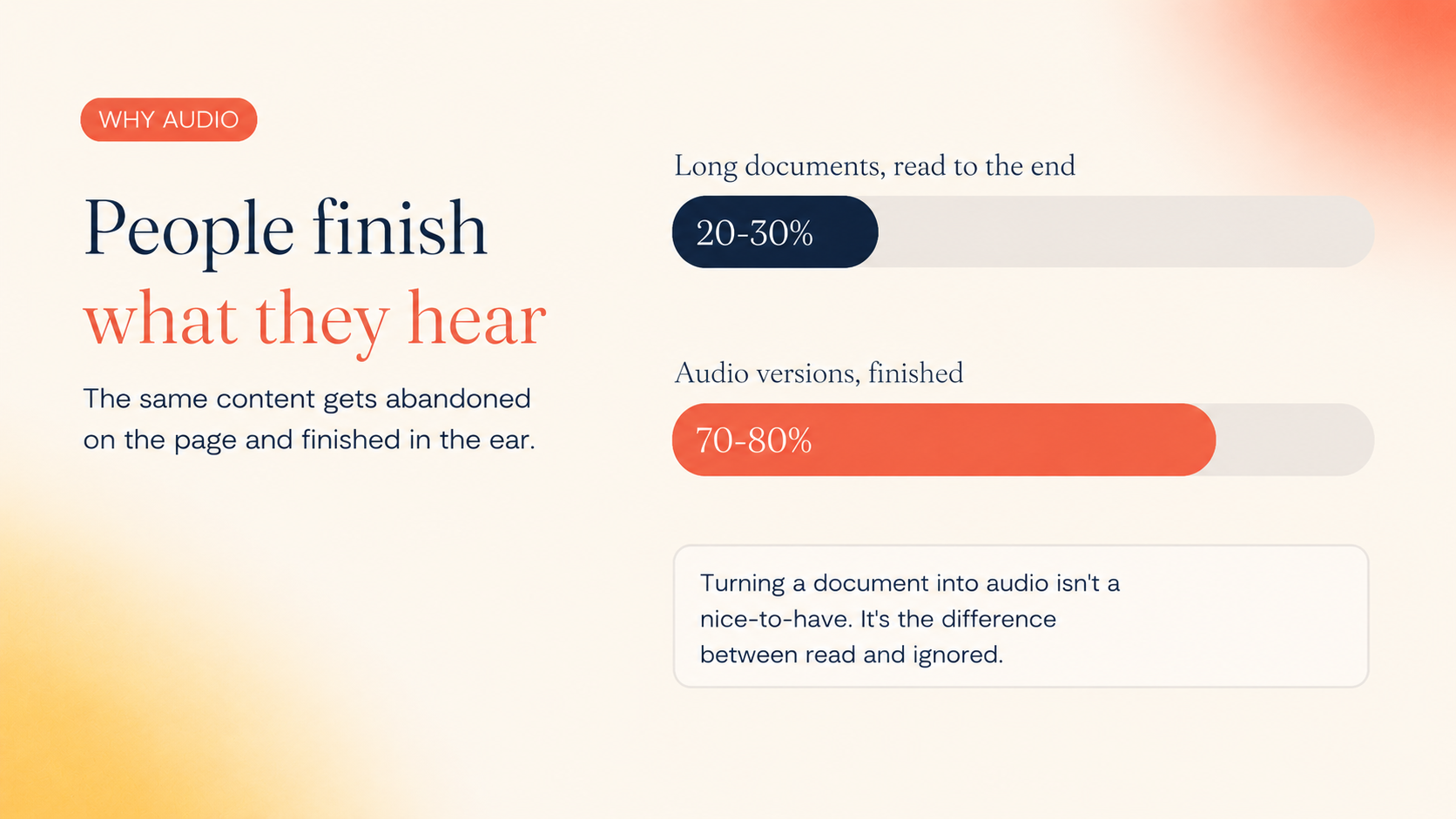
This is the real thesis behind what we call the unread problem: the format that wins is not the one with the best theoretical comprehension score. It is the one people actually finish.
Why this is not the same as text-to-speech#
If completion is the goal, why not just run every document through a text-to-speech engine and call it done? Because a robotic word-for-word reading of a dense report has the same structural problems as the report itself, just spoken instead of typed. It does not restructure a 12-page whitepaper into something a listener can follow without the visual scaffolding of headers, bullet points, and page breaks that a reader relies on.
Turning a document into something people actually finish means rewriting it for the ear: converting dense paragraphs into a conversation, adding the context a listener needs since they cannot flip back a page, and pacing it so someone driving to work can follow it without rereading. That is a different job than text-to-speech, and it is the one Sprep is built around. Full disclosure: we make Sprep, so take the next part as an interested party's pitch, not neutral advice.
Sprep converts PDFs, slide decks, Word documents, and articles into two-host conversational podcasts, not single-voice narration. Every script goes through a human-in-the-loop editor first: the AI drafts it, a person reviews and approves every word, and only then does audio get generated. That step exists specifically because of the accuracy problem above. Fully automated one-shot tools tend to sound polished but quietly get details wrong, and reviewing the script before it becomes audio is the fix. It also means the finished piece is genuinely restructured for listening, with a chapter-based table of contents generated automatically from the source document, not just text read aloud.
None of that changes the honest research above. Audio will not out-comprehend a careful reader of dense material. What it does is get far more of your intended audience to the end, instead of adding one more unread item to a pile that is already too tall.
Where audio is the wrong answer#
Being explicit about this, because a format argument that has no limits is a sales pitch rather than an argument.
Anything people need to reference. Thresholds, figures, rates, definitions, contractual terms. Nobody should be scrubbing through audio to check a number, and a listener who needs to verify something has no way to do it.
Anything requiring a signature or forming part of a compliance record. The written document remains the version of record, always. Audio can sit alongside it as a comprehension layer, never in place of it.
Anything urgent. A message someone might not listen to for two days is a poor vehicle for something needed this afternoon.
Anything genuinely visual. If the chart is the argument, or the process only makes sense as a diagram, converting it to speech removes the thing that carried the meaning.
Anything that was unclear in writing. Conversion is faithful to what it is given. An ambiguous policy becomes an ambiguous episode, delivered more fluently, which is worse rather than better.
What this means if you send a lot of internal communication#
If you run comms, L&D, or executive updates, the unread problem is not really about format at all. It is about matching the format to how much attention people actually have left to give you. A policy update that needs word-for-word precision probably still belongs in writing, with an audio companion for people who will not otherwise get to it. A quarterly all-hands recap, an onboarding walkthrough, or a compliance training module is a stronger candidate for audio first, because completion matters more than perfect recall of every clause.
The engagement side of the same problem, why updates get opened and then abandoned, is covered in why employees don't read company updates.
Dätwyler, a Sprep customer, uses this approach for onboarding and internal communications specifically because new hires and distributed teams are the groups least likely to finish a dense written packet in their first week.
Three things worth doing this week#
None of these require budget or new tooling.
Find your worst offender. The longest document you send regularly that you have no completion data for. If you cannot say what proportion of recipients finish it, you do not know whether it is working, and the odds are against it.
Cut one recurring item permanently. Every organisation has a standing newsletter, report, or update with effectively no engagement. Retiring it buys back attention for everything else you send, and it is the only intervention here that costs nothing and helps immediately.
Change the format of one thing that matters. Take the single most important message you send that people are not finishing, and deliver it in a way they can consume when reading is impossible. That is the cleanest test of whether format, rather than content, was the constraint all along.
FAQ#
Why do people leave so many emails and messages unread? Partly overload, partly psychology. Once daily unread volume passes roughly 50 messages, research links it to measurable anxiety and slower decision-making. Each unread item also creates an open loop that keeps quietly consuming attention even when you are not looking at it.
Why don't employees read internal communications? Mostly because reading competes with everything else demanding their attention, not because the writing is bad. Long-form content typically sees only 20 to 30 percent of readers reach the end, and knowledge workers already spend close to a fifth of their week just searching for information.
Why do people abandon documents so early? Because abandonment is usually a decision made in the first seconds rather than a gradual loss of interest. People scan a document's length, density, and opening line, estimate the cost of reading it, and decide. This is why adding more content to improve thoroughness often reduces completion.
Does listening to audio improve information retention compared to reading? Not consistently. For simple or narrative content, comprehension is roughly equal across formats. For dense or technical material, research shows reading often produces better recall than listening. Audio's real advantage is completion rate, not raw comprehension.
What's the difference between text-to-speech and document-to-podcast tools? Text-to-speech reads your existing text aloud word for word. Document-to-podcast tools restructure the content into a conversation designed for listening, with pacing, context, and structure that a plain readout does not have.
How much does poor internal communication cost companies? Estimates vary by source. Axios HQ puts it between $3,640 and $37,440 per employee per year depending on salary. Grammarly's research with Harris Poll estimates roughly $9,284 per employee per year, or $9.3 million annually per 1,000 employees.
Is audio content actually more likely to get finished than written content? Yes, by a wide margin. Podcast episodes average 70 to 80 percent completion rates, compared with 20 to 30 percent of readers reaching the end of long-form written content.
When should content stay written rather than becoming audio? Anything people need to reference precisely, anything requiring a signature or forming part of a compliance record, anything urgent, and anything genuinely visual where a chart or diagram carries the meaning. Audio works alongside these, never instead of them.
Does making documents shorter fix the unread problem? It helps, since shorter pieces see meaningfully higher completion, but it does not solve it. The constraint is total available attention rather than any individual document's length, so shortening one item while the overall volume keeps rising produces limited improvement.
What's the fastest way to test whether format is the problem? Take the most important thing you send that people are not finishing and deliver the same content in a format they can consume when reading is impossible. If completion improves substantially without changing the content, the constraint was format rather than writing quality.
Get the next one before it's written#
This is the first in a running series on why workplace content goes unread and what actually gets it finished. If that is a problem you think about, our newsletter covers it every issue, and true to the argument above, each issue ships as both a short read and a prep-generated audio version, so you can judge the format tradeoff yourself instead of taking our word for it.
If you would rather test the completion-rate argument on your own document right now, Sprep's free plan turns one document into a podcast, script review included, no card required.
See it in action