
The one-sentence difference#
Text to speech reads your words aloud. Text to podcast rewrites them into a conversation and then reads that aloud. One preserves your text exactly and voices it. The other restructures your text into something built for listening, usually a two-host discussion, and voices that instead.
That single distinction, preserve versus restructure, explains every other difference between them, and it is the reason picking the wrong one leaves people disappointed. If you wanted your exact words and got a chatty two-host reinterpretation, you feel it lost fidelity. If you wanted something engaging and got a flat verbatim readout, you feel it is boring. Neither tool failed. They were built for different jobs.
This guide explains what each one is, where each is genuinely the right choice, and how to tell which you need. We make a text-to-podcast tool, so we will be careful to be fair to text to speech, because for a lot of users it is the better answer.
What text to speech actually is#
Text to speech, or TTS, is the older and more established technology. It takes written text and produces a spoken version of that exact text, read by a single synthetic voice, in order, word for word.
You have used it. Screen readers, the "listen to this article" button, your phone reading a message aloud, audiobook-style narration of a document. Modern TTS voices are remarkably natural, a long way from the robotic monotone people remember, and the best of them are hard to distinguish from a human reading aloud.
The defining feature is fidelity. TTS does not change your words. It does not summarise, restructure, add a second speaker, or interpret. It reads exactly what is on the page, which is precisely what makes it valuable for the jobs it suits.
What text to podcast actually is#
Text to podcast is newer, and it does something fundamentally different. It takes your text and rewrites it into a new form designed for listening, then generates audio of that new form. In almost every current tool, that new form is a conversation between two hosts who discuss the content, rather than one voice reading it.
The key word is rewrite. A text-to-podcast tool does not read your document. It produces a script, a back-and-forth in which one host explains, the other asks the questions a listener would ask, and the material gets unpacked as dialogue. Then it voices that script. What you hear is not your text; it is a discussion about your text.
This is why the output can feel more engaging and easier to follow than a straight reading, and also why it can drift from your exact meaning, because something in between wrote a new script from your source. Both of those follow from the same restructuring step.
Why the restructuring matters: how listening actually works#
The reason text-to-podcast exists at all comes down to a fact about how spoken information is processed, and it is worth understanding because it explains when restructuring helps and when it is unnecessary.
Written text is built for eyes. It uses paragraphs, headings, punctuation, and bullet points to signal structure, and a reader navigates that structure visually, skimming ahead, glancing back, and rereading a hard sentence. None of that survives being read aloud. A listener cannot see the structure, cannot skim, and cannot reread.
Spoken information is also transient. Once a sentence has passed, it is gone unless the listener holds it in working memory. Long sentences with subordinate clauses, which read elegantly on a page, are genuinely hard to follow when they arrive at someone else's pace, while you are driving.
Text to speech inherits all of this. Reading a dense document aloud, word for word, produces audio with the same structure that was built for eyes, which is why a straight TTS reading of a complex report often loses the listener even though the voice sounds fine. Text to podcast tries to solve exactly this by rewriting the content into a form built for ears: shorter spoken sentences, a question-and-answer rhythm that creates natural checkpoints, and context added where a listener cannot look back. When the source is dense, that restructuring is the difference between finishing and drifting off. This is the core of what we call the unread problem, applied to audio: the format that gets finished wins.
Side by side#
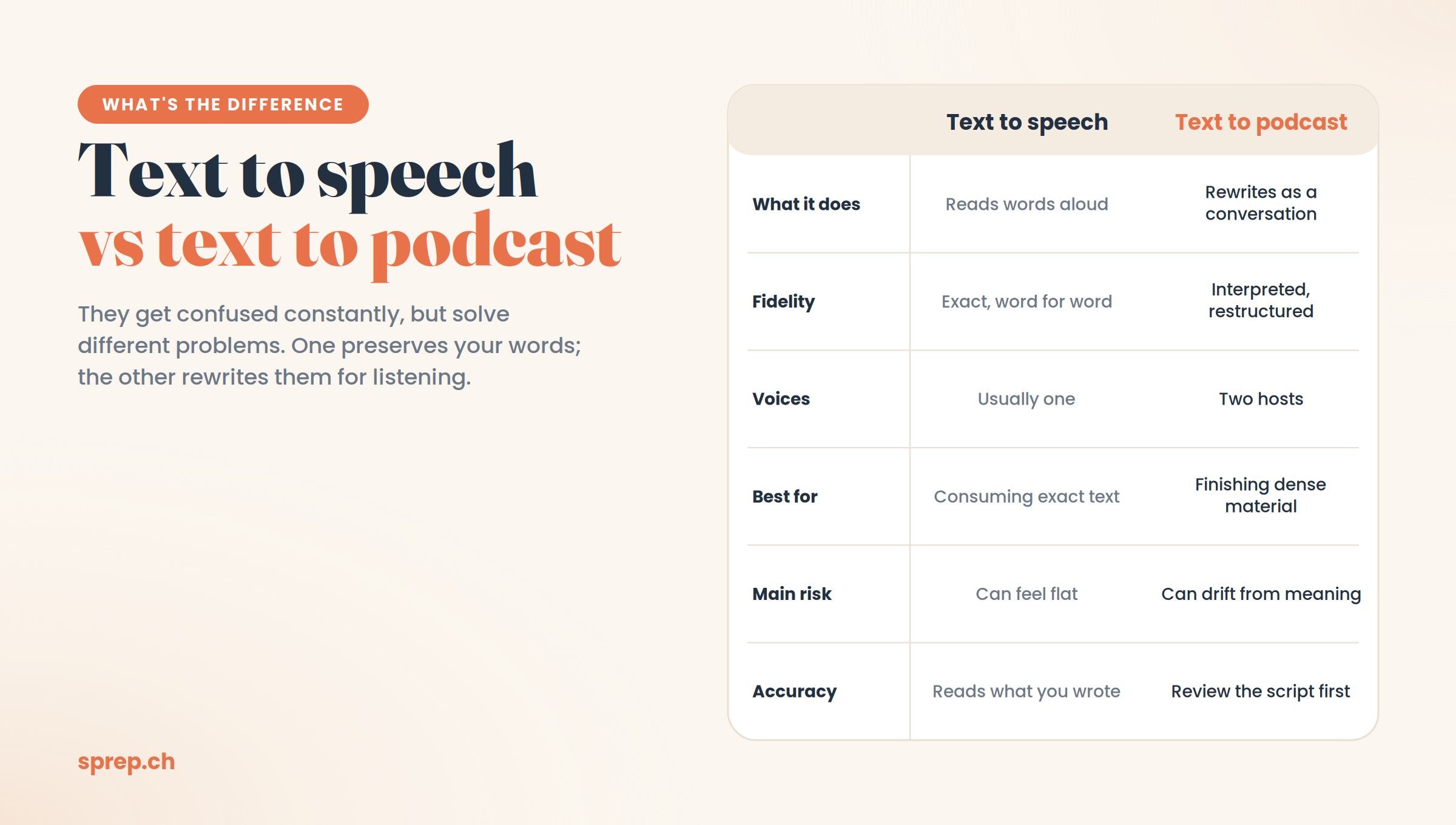
| Text to speech | Text to podcast | |
|---|---|---|
| What it does | Reads your text aloud | Rewrites your text as a conversation, then reads that |
| Fidelity to your words | Exact, word for word | Interpreted and restructured |
| Voices | Usually one | Usually two hosts |
| Best for | Consuming exact text | Understanding and finishing dense material |
| Risk | Can be flat or hard to follow if the source was | Can drift from your precise meaning |
| Accuracy concern | Low, it reads what you wrote | Higher, it rewrites what you wrote |
When text to speech is the right choice#
Be clear about this, because text to podcast is not universally better, and plenty of use cases genuinely call for TTS.
When you need the exact words. Legal text, precise instructions, anything where a paraphrase would be wrong. TTS gives you fidelity; text to podcast cannot promise it.
When you are consuming your own reading. Getting through articles, a book chapter, or your inbox hands-free. You want the actual content, not a discussion of it.
Accessibility. Screen readers and reading support for people who need text voiced. Here, faithful reading of the exact words is the entire point, and restructuring would defeat it.
Short or already-conversational content. A brief update or a casually written note does not need restructuring, so TTS reads it perfectly well and faster.
When speed and simplicity matter. TTS is instant and predictable. There is no script to review because nothing was rewritten.
The disadvantages of TTS are real but narrow: on long, dense, structured material it inherits the structure that was built for eyes, so it can be a slog to follow. That is not a flaw in the technology; it is a mismatch between the source and the format, and it is exactly the mismatch text to podcast was built to fix.That mismatch is most visible with slide decks, whose sparse text reads badly aloud, covered in turning a PowerPoint into a podcast.
When text to podcast is the right choice#
When the source is dense and you want people to finish it. Reports, whitepapers, research, policy documents. Restructuring into a conversation is what keeps a listener to the end, where a straight reading would lose them.
When it is for an audience, not just yourself. If other people will hear it, the engagement of a conversational format matters, and the podcast form is what makes it something people choose to listen to rather than endure.
When you are publishing. A podcast format fits podcast feeds, internal channels, and the way people actually consume audio content, in a way a document readout does not.
When comprehension of the ideas matters more than the exact words. If the goal is that people understand the argument, and the precise phrasing is not sacred, restructuring for listening serves that better.
The trade-off to accept: because text to podcast rewrites your content, it can introduce small inaccuracies or shifts in emphasis. AI-generated audio of this kind is typically around 95 percent faithful to the source, with the rest subtly off. For personal use that is fine. For anything published, it is why the better text-to-podcast tools let you review and edit the generated script before the audio is made, so you catch the drift before anyone hears it. The full field of tools is compared in 7 best AI podcast generators in 2026.
How to decide in one question#
Ask: Do I need my exact words, or do I need people to understand and finish this?
If you need the exact words, faithfully voiced, choose text to speech. Legal content, accessibility, your own reading, precise instructions.
If you need people to actually get through dense material and absorb the ideas, choose text to podcast, and if it is going to an audience, choose one that lets you review the script.
Most of the confusion between these two comes from people reaching for one when they wanted the other. A publisher wanting an engaging show tries TTS and finds it flat. A lawyer wanting exact wording tries text to podcast and finds it paraphrased. Match the tool to the job and both work well. The wider question of how any document becomes good audio is covered in document to podcast: how to turn any file into audio people finish.
Want to hear what a real AI podcast sounds like?#
Hear how written content changes when it is restructured into a conversational podcast rather than simply read aloud.
See What a Real AI Podcast Sounds Like
Where Sprep fits#
We make Sprep, which is a text-to-podcast tool, so this is us describing our own category. We will keep it brief and honest.
Sprep restructures a document into a two-host conversation and, importantly for the accuracy trade-off above, lets you review and approve the script before any audio is generated. That review step is the answer to the main downside of text to podcast: it is where you catch the small drifts in meaning that restructuring can introduce, before they reach a listener.
But if what you actually need is text to speech, your exact words read aloud for accessibility, for consuming your own reading, or for legal precision, then Sprep is not your tool, and a good TTS reader is. We would rather tell you that than sell you a conversation you did not want. Text to podcast is the right choice when the goal is understanding and completion of dense material for an audience. For everything fidelity-first, text to speech wins.
Keep learning the category#
This is one piece of a broader argument about why so much good content goes unheard, and what formats fix it. If that is a question you think about, our newsletter covers it regularly, and, fittingly, each issue comes as both a short read and a text-to-podcast audio version, so you can judge the difference yourself.
FAQ#
What is the difference between text to speech and text to podcast? Text to speech reads your exact words aloud in a single voice, preserving your text word for word. Text to podcast rewrites your text into a conversation, usually two hosts, and voices that instead. One preserves fidelity; the other restructures for listening. That single difference explains all the others.
Is text to podcast better than text to speech? Neither is universally better; they suit different jobs. Text to speech is better when you need your exact words, for accessibility, legal content, or consuming your own reading. Text to podcast is better for helping an audience understand and finish dense material, because restructuring into a conversation keeps listeners engaged.
Does text to speech change your words? No. Text to speech reads your text exactly as written, in order, without summarising, restructuring, or adding a second voice. This fidelity is its main advantage for uses where the precise words matter, such as legal text, accessibility, or precise instructions.
Why does text to podcast use two voices? Because a conversation is easier to follow than a monologue when you are listening rather than reading. A two-host format creates natural checkpoints through questions and answers, adds context a listener cannot look back for, and breaks dense material into a back-and-forth rhythm that holds attention better than a straight reading.
Is text to podcast accurate? Mostly, but not perfectly. Because it rewrites your content rather than reading it verbatim, it can introduce small inaccuracies or shifts in emphasis, typically leaving the output around 95 percent faithful to the source. For anything published, using a tool that lets you review the script before generating audio is how you catch the drift.
When should you use text to speech instead of text to podcast? When you need your exact words, when the content is for accessibility, when you are consuming your own reading, when the material is legal or precise, or when the source is short and already conversational. In these cases fidelity matters more than engagement, and restructuring would work against you.
Can text to speech make a podcast? It can produce audio of a document, but it will be a single voice reading verbatim rather than a conversational show. Whether that counts as a podcast depends on what you want. If you want an engaging, listenable episode of dense material, a text-to-podcast tool that restructures the content is usually the better fit.
What are the disadvantages of text to speech? Its main limitation is that it inherits the structure of the source. Reading a long, dense, visually structured document aloud word for word produces audio that is hard to follow, because the structure was built for eyes and does not translate to ears. For simple or short content this is not an issue; for complex material it is.
Which is better for accessibility, text to speech or text to podcast? Text to speech, in almost all cases. Accessibility tools like screen readers exist to voice the exact content faithfully, so a person gets the same words a sighted reader would. Restructuring that content into a conversation would change what is being conveyed, which defeats the purpose of accessible reading.
How do I choose between text to speech and text to podcast? Ask one question: do you need your exact words, or do you need people to understand and finish the material? Exact words point to text to speech. Understanding and completion of dense content, especially for an audience, point to text to podcast, ideally one that lets you review the script if it is being published.
See it in action