
The uncomfortable timeline first#
There are no shortcuts to building a podcast audience organically, and expecting otherwise is what causes most people to quit before anything works. Realistic organic growth takes at least six months to show meaningful traction. Creators with twenty published episodes commonly report reaching only around 50 listens per episode. That is not a failure state. That is normal, and most growth advice fails to say so before listing eleven tactics.
If you need the six-month version to be true before you start, this is a good moment to check that. Everything below works. None of it works by Tuesday.
The lever almost nobody uses#
Ask working podcasters what actually moved their numbers, and one specific tactic comes up again and again, and it is not the one most growth guides lead with.
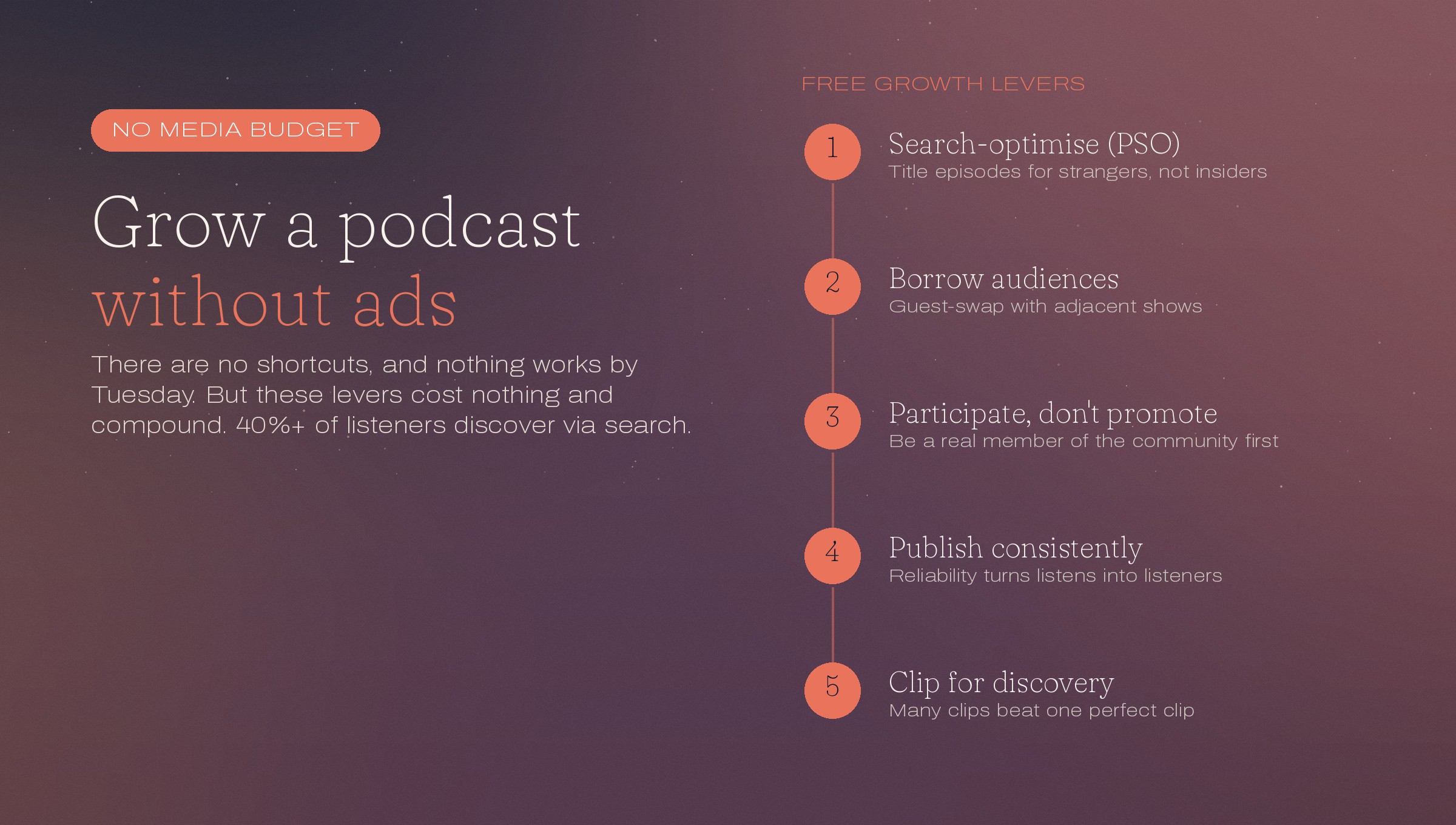
Podcast Search Optimization, sometimes shortened to PSO: writing your show title, episode titles, and descriptions using the exact words a stranger would type into Apple Podcasts or Spotify search. Over 40 percent of listeners find new shows through in-app search. That is a larger discovery channel than most creators realize exists, and almost nobody optimizes for it, because it does not feel like marketing. It feels like paperwork.
Try this right now: open a podcast app and type the topic your show covers. Look at what appears. If your show's actual words, the ones in your title and episode names- do not match what is showing up, you are invisible to everyone actively searching for exactly what you make. Not underperforming. Invisible. Search cannot surface a show whose metadata does not contain the query.
The single most common mistake is titling episodes for people who already listen rather than for strangers who have never heard of the show. "Episode 47: Checking In" tells an existing listener nothing new and tells a searcher nothing at all. "Why Your First Product Launch Will Fail" tells a stranger exactly what they are about to get.
What to actually change:
- Your show name should contain the words someone would search, not just a clever phrase. A show called "The Deep End" about media analysis is invisible to search. "Media Analysis Podcast: The Deep End" is not.
- Episode titles should be specific and literal. State the topic, not a teaser. Save the personality for the description.
- Descriptions should use your core topic phrase in the first sentence, not the fourth.
- Consistency across episodes matters, since apps weight shows that repeatedly use the same core terms as topically relevant, similar to how a website builds relevance for a keyword over time.
This is free, takes an afternoon for your back catalog, and according to creators who have actually tracked it, it outperforms most of what people spend money on instead.
Borrow an audience that already exists#
The second most consistently mentioned tactic, across creators with genuinely different show sizes, is some version of putting yourself in front of an audience someone else already built.
Guest swaps with adjacent shows. Appearing on a podcast with a similar but not identical audience puts you in front of people who have already proven they listen to podcasts about your general topic. That is a meaningfully warmer audience than a stranger scrolling social media, and it costs nothing but the time of the conversation.
Genuine participation in existing communities, not promotion. Subreddits, Discord servers, and forums built around your topic already have people discussing exactly what your show covers. The creators who report this working consistently describe the same rule: spend the large majority of your time participating in discussions with no mention of your show at all, and only share it occasionally, once you are recognized as a real participant rather than someone who showed up to drop a link. Reddit specifically has a low tolerance for the opposite approach, and it shows in how quickly self-promotional accounts get removed.
Being interesting to people who do not know you yet. This sounds obvious and is the thing most new shows get wrong. If your content assumes the listener already knows your inside jokes, your co-host's name, or the backstory from episode one, you have built something for people who already found you rather than something built to be found. Structure early episodes so a total stranger understands what is happening and why they should care within the first minute.
What consistency actually buys you#
Every experienced creator says some version of "be consistent," and it is worth being specific about why, because the vague version is not persuasive.
Consistency is what turns "listens" into "listeners." A single good episode gets sampled once. A show that reliably publishes on the same schedule gives people a reason to subscribe rather than just play one episode and move on, because subscribing implies a promise that more is coming on a predictable rhythm. Break the rhythm and you are asking people to re-decide whether they still care, repeatedly.
It is also a trust signal for new listeners. Someone finding your show for the first time can see your publishing history. A show with three episodes in the last two months signals abandonment risk, correctly, given how common podfade is. A show with two years of reliable biweekly episodes signals that starting to listen is a safe bet.
Frequency matters less than reliability. A show that publishes every two weeks without fail will outperform one that aims for weekly and manages it inconsistently. Pick the cadence you can sustain during a bad month, not the cadence that looks impressive on a good one.
Turn episodes into more entry points, without diluting the show#
Short clips from your episodes distributed on social platforms function as a discovery layer, not a replacement channel. The rule from people who have actually run this at scale: content going viral is never guaranteed, regardless of quality, so treat it as a numbers game rather than a strategy that is supposed to work every time. Consistency across many clips beats obsessing over making one perfect clip.
Two things matter more than most creators expect. Titles and thumbnails on clips are what earn the click before anyone hears a word, and they are the most commonly underinvested part of the process. And clips should be chosen by looking at what actually got engagement in the full episode, not by guessing which moment felt good while recording. The same logic runs in reverse if you have written archives, which is covered in repurpose blog posts into audio in minutes.
The connection back to search optimization is not a coincidence. A clip that goes nowhere still costs you nothing extra, since it was pulled from content you already made. A show that is easy to find in search converts every one of those casual clip-viewers who then go looking for the full show into an actual listener. The two tactics compound.
Reviews and word of mouth still work, quietly#
Ratings and reviews on Apple Podcasts and Spotify influence how your show ranks in search and category browsing, which loops back to the search optimization work above. Asking listeners directly for a review, ideally at a specific moment in an episode rather than as a generic outro line every time, produces meaningfully more reviews than hoping people think to leave one unprompted.
Word of mouth is the least controllable growth channel and, for shows that get past the first year, often becomes the largest one. The only lever you have over it is making an episode specific and good enough that someone feels the need to send it to one particular person they were thinking of. General competence rarely gets forwarded. A sharp, specific point does.
The clip and repurposing work described above is really a specific case of a broader idea, covered in our guide to content repurposing: one asset can reach several different moments of someone's attention if you design each version for a different one, rather than just cutting the same thing smaller.
What not to bother with yet#
Being direct about where effort is commonly wasted at small scale:
A podcast website with a blog, before you have an audience worth writing for, is usually premature. It compounds over time and is worth building, but it is not the first six months' priority. If you already have a newsletter list, that is a warmer starting point than a website, and the mechanics are in how to turn your newsletter into a podcast.
Cross-platform presence on every network simultaneously. Pick one platform where your actual audience already spends time and go deep before spreading across five.
Paid growth services and follower-buying, which several genuinely engaged commenters warned against. Purchased followers and engagement do not convert to listeners and can quietly damage how platforms weigh your account.
Obsessing over download counts before fifty episodes. Early numbers are noisy and small. The metadata, consistency, and community work compounds in ways that do not show up cleanly on a week-to-week graph.
Where Sprep fits#
We build a document-to-podcast tool, so treat this as an interested party talking, and this is a smaller piece of the growth picture than the sections above.
If part of what is limiting your consistency is the production overhead- recording, editing, and publishing eating the time you would rather spend on the community and clipping work described above- converting existing writing into episodes removes a step. It turns things you have already written- blog posts, newsletters, Substack pieces- into two-host conversational podcast episodes, with a person reviewing the script before audio is generated. It will not fix your metadata, book your guest swaps, or write your clip titles. What it can do is make a second show, or a bonus episode schedule, sustainable without doubling your recording time, which is one legitimate answer to the reliability problem described above. If you have not published your first episode yet, start with our guide on how to start a podcast with no equipment.
FAQ#
How long does it take to grow a podcast audience? There are no reliable shortcuts, and realistic organic growth generally takes at least six months to show meaningful results. It is common for shows with twenty published episodes to still be averaging only around 50 listens per episode. Treat that as the normal early trajectory rather than a sign something is wrong.
What is Podcast Search Optimization? PSO means writing your show title, episode titles, and descriptions using the exact words a stranger would type into a podcast app's search bar, rather than titles that only make sense to existing listeners. Over 40 percent of listeners discover new shows through in-app search, making this one of the highest-leverage free changes available.
How do you get your first 1,000 podcast listeners without ads? Combine specific, search-friendly titling with genuine participation in communities built around your topic, guest appearances on adjacent shows with an overlapping audience, and a publishing schedule you can sustain reliably. None of these cost money, and all of them compound faster together than any single tactic alone.
Do podcast clips on social media actually grow your show? They function as a discovery layer rather than a guaranteed growth channel. No individual clip going viral is reliable, so consistency across many clips outperforms trying to engineer one perfect one. Clip titles and thumbnails matter more than most creators expect, since they determine whether anyone clicks before hearing a word.
Should you buy followers or use paid growth services to grow a podcast? Generally no. Purchased followers and engagement do not convert into actual listeners and can affect how platforms weigh your account. The tactics that consistently work- search optimization, guest swaps, and community participation- cost time rather than money and produce listeners who actually listen.
How important is publishing consistency for podcast growth? Very. Consistency is what converts a one-time listen into a subscriber, since a reliable schedule signals that more content is coming and gives people a reason to follow rather than sample once. A publishing history also functions as a trust signal, since new listeners can see whether a show has a track record of continuing.
What should new podcasters focus on before worrying about download numbers? Search-friendly metadata, a sustainable publishing cadence, and genuine participation in communities related to the topic. Download counts in the first fifty episodes are noisy and do not reflect whether the underlying growth work is compounding, which typically takes months to show up clearly.
Do guest appearances on other podcasts really help grow an audience? Yes, more consistently than most other tactics, because it puts you in front of people who have already proven they listen to podcasts about a related topic. That is a warmer audience than a cold social media impression, and it costs only the time of the conversation.
How do reviews and ratings affect podcast growth? They influence ranking in search and category browsing on platforms like Apple Podcasts and Spotify, which connects directly to discoverability. Asking for a review at a specific, natural moment in an episode produces more responses than a generic request repeated in every outro.
What is the biggest mistake new podcasters make when trying to grow? Titling and describing episodes for people who already listen rather than for strangers who have never heard of the show. If a show's language does not match what a searcher would actually type, it will not surface for the exact people looking for content like it, no matter how good the content is.
Keep episodes coming without doubling your workload#
If production time is what's making consistency hard, the free plan turns one thing you've already written into a full podcast episode of up to 15 minutes, with the script editor included so you can review every word before audio is generated.
See it in action