
What employee onboarding actually is#
Employee onboarding is the structured process of integrating a new hire into an organization, running from offer acceptance through their first year. It is not orientation. Orientation is an event, usually lasting a day or a week, that covers paperwork, systems, and a tour. Onboarding is the entire arc of turning someone who accepted a job into someone productive, connected, and intending to stay.
That distinction matters commercially, because the organizations treating onboarding as an event are the ones with the worst outcomes. And most organizations treat it as an event.
The data is blunt#
Gallup's research on this is the number worth remembering: Only about 12 percent of employees strongly agree that their organization does a great job of onboarding new hires. Roughly nine in ten new starters experience onboarding as inadequate.
The downstream numbers follow logically:
- Only around 29 percent of new hires say they felt fully prepared and supported to excel in their role after onboarding.
- Approximately 20 percent of employee turnover happens within the first 45 days.
- Around a third of new hires start looking for another job within six months.
- New hires typically take six to seven months to feel settled, and roughly eight months to reach full productivity.
The window is also shorter than most HR teams plan for. Enboarder's 2025 HR Leader Survey found that 86 percent of employees decide how long they intend to stay within their first six months. Meanwhile, only about 10 percent of companies sustain any onboarding activity beyond the first year, and most stop at week two.
The upside case is equally well documented, if you allow for the fact that these figures circulate widely across HR vendor research and are worth treating as directional rather than precise. Structured onboarding programs are associated with retention improvements around 82 percent and productivity gains around 50 percent, and new hires who go through structured onboarding are substantially more likely to still be there after three years.
The framework: Bauer's C's, and the one everybody gets wrong#
The dominant model in onboarding research comes from Dr. Talya Bauer, who developed the 4 C's in a 2010 whitepaper for the SHRM Foundation, Onboarding New Employees: Maximizing Success. It remains the most widely referenced onboarding model in HR research.
A clarification, because most articles on this get it wrong. Search results will tell you the 5 C's are Compliance, Clarification, Culture, Connection, and Check-back. That is not Bauer's version. Bauer's original four were Compliance, Clarification, Culture, and Connection. She later expanded them to five by adding Confidence, and separately added Checkback as a sixth. So Check-back is the sixth C, not the fifth. If you are citing this framework in a board deck, cite Confidence as the fifth.
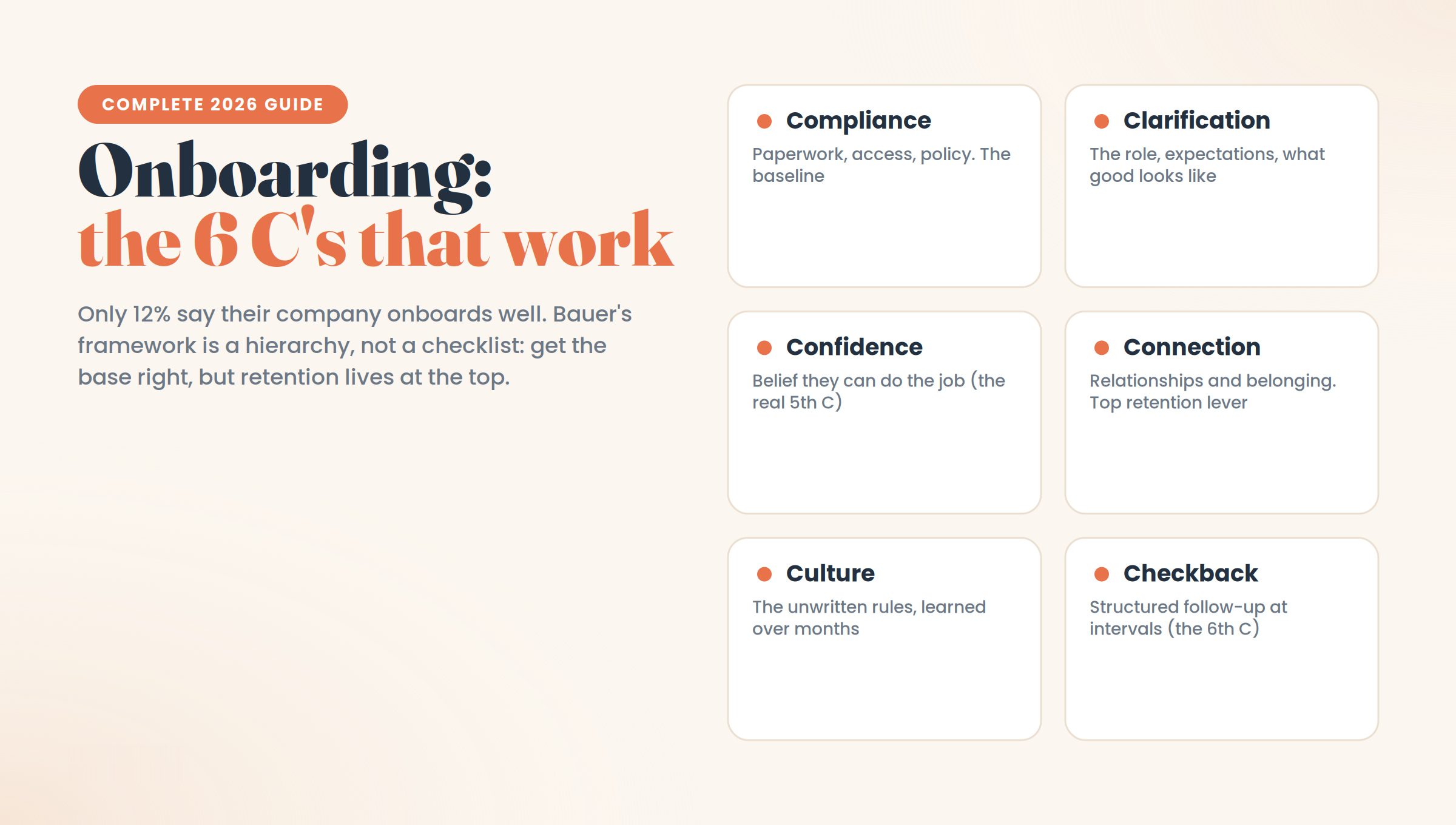
Here is what each level means in practice.
Compliance#
The baseline: contracts, tax and eligibility paperwork, policy acknowledgments, safety and regulatory training, equipment, system access, badges, benefits enrollment. Bauer describes this as the housekeeping of onboarding. Every organization must do it to stay in business, including ones that claim to have no onboarding program at all.
Most companies do this part competently. The problem, as the rest of this guide argues, is that many do little else.
Clarification#
Whether the new hire understands their role, what is expected, what good performance looks like, and how their work connects to the organization's goals. Role clarity is one of the strongest predictors of new hire adjustment in the research literature. It sounds obvious and is routinely skipped because everyone assumes the job description covered it. Job descriptions describe the role that was advertised, not the job as it actually exists.
Confidence#
Whether the new hire believes they can do the job. This is self-efficacy, and it is the C most often omitted from the popular version of the framework. It matters because a capable person who does not yet feel capable will underperform, avoid asking questions, and disengage. Early wins, achievable first assignments, and explicit permission to not know things all build it.
Connection#
Relationships, networks, and the sense of belonging to a team. This is consistently the strongest lever for retention, and consistently the last thing anyone gets to. Bauer's own observation is pointed: many employees spend their first day filling out forms and miss the opportunity for connection entirely.
Culture#
The unwritten rules. How decisions actually get made, what gets rewarded, what "urgent" really means here, who to ask about what. Culture cannot be transmitted by a values slide. It is learned through exposure, stories, and observation, which is why it takes months rather than days.
Checkback#
The sixth C, and the operational one: structured follow-up at intervals to catch problems while they are still fixable. Most programs have no mechanism for this, which is why the first anyone hears of a problem is the resignation.
The critical insight in Bauer's model is that these are a hierarchy, not a checklist. Compliance and clarification are the foundation. Connection and culture are what actually drive retention. You cannot skip to the top, but you also do not get the retention benefit by only doing the bottom.
Three levels of onboarding maturity#
Bauer's research also describes where organizations actually sit, and the distribution is sobering.
Passive onboarding. Compliance is covered, maybe some basic role clarification. Culture and connection are not addressed. Onboarding is treated as a checklist of unrelated tasks. Roughly 30 percent of organizations operate here.
High-potential onboarding. Compliance and clarification are well covered, and some culture and connection mechanisms exist, but nobody is coordinating them, and the process is not systematic across the organization. Roughly 50 percent sit here. This is the most common state, and the most frustrating, because the components exist but nothing is orchestrating them.
Proactive onboarding. All levels are addressed systematically and strategically. This is the minority.
If you are trying to place your own organization, the diagnostic question is not "do we have onboarding materials?" It is "does anyone own the outcome, and does the process run the same way twice?"
The stages, from preboarding to the first year#
Preboarding (offer acceptance to day one). The most underused window in the entire process. The new hire is enthusiastic, has time, and is receiving nothing except, typically, a large document pack. This is the phase where organizations either build anticipation or start the relationship with an administrative burden.
Day one. Should be about connection and orientation, not forms. If a new hire spends day one filling out paperwork, you have spent your single highest-attention day on your lowest-value C.
Week one. Role clarification, first assignments, key relationships, systems access working. The goal is a first small win.
30-60-90 days. The standard ramp structure: learning at 30, contributing at 60, owning at 90. Worth noting that a substantial share of organizations, around 45 percent in Enboarder's research, provide only general guidelines here and leave execution to individual managers, which makes ramp quality a lottery based on which manager someone got.
Six to twelve months. Where onboarding should continue and rarely does. Given that people take six to seven months to feel settled and 86 percent decide their tenure intention within six months, stopping at week two means you stop precisely when the decision is being made.
The compliance trap#
Here is the structural problem underneath most failing onboarding programs, and it is not a lack of good intentions.
A TalentLMS and BambooHR survey found that roughly 40 percent of onboarding time is consumed by compliance activities. Compliance is the lowest-value C for retention and the one every organization already does adequately. It is eating nearly half the available time, and the time it takes comes directly out of connection and culture, which are the C's that actually determine whether someone stays.
This shows up most acutely in preboarding, where the standard practice is to send the new hire a document pack. Employment terms, working-time rules, safety procedures, IT and security policies, benefits documentation, the code of conduct, site-specific procedures. In an industrial or regulated environment this routinely runs to well over a hundred pages before someone's first day.
Nobody reads it. This is not a criticism of new hires; it is the predictable behavior of a person handed a document pack they cannot triage, on a deadline, with no context, before they have met anyone. It is the onboarding-specific case of the unread problem: long documents get abandoned, and the information you legally distributed is not the information anyone actually received.
The consequence is a double loss. The compliance content does not land, so it gets re-explained in person during week one, consuming manager time. And because it consumed the preboarding window, the connection and culture work that drives retention never got its slot.
Related: InsightGlobal research found that 78 percent of workers say they are missing at least one thing they need to succeed, with knowledge libraries and general training among the gaps. The information exists in most organizations. It is not reaching people in a usable form. Compliance content has its own version of this problem, which we cover in compliance training people actually complete.
What good looks like, concretely#
A realistic structure that respects the hierarchy:
Preboarding. Send a short welcome, the team they will meet, and their first-week schedule. Move compliance documents into a format that can actually be consumed before day one, and keep the written versions available as the reference of record. Ask them one question they would like answered before starting. A full episode-by-episode structure for that preboarding material is in cut onboarding ramp time: turn docs into a welcome podcast.
Day one. No forms before lunch. Manager one-to-one, team introductions, a real conversation about the role. Compliance paperwork in the afternoon, batched.
Week one. A defined first task that produces a visible result. Introductions to five named people with a stated reason for each. Explicit statement of what success looks like at 30, 60, and 90 days, in writing.
Weeks two to four. Role-specific training. A buddy or connectivity partner separate from the manager. First check back at 30 days with actual questions, not "how's it going?"
Months two and three. Increasing ownership, second checkback at 90 days, and a candid conversation about what is still unclear.
Months four to twelve. Continued checkbacks at six months and one year. This is the phase almost nobody does and the one the retention data most supports.Spacing that reinforcement is what makes it stick, and the intervals are covered in microlearning: how to train teams in small bites.
Common onboarding mistakes#
The recurring ones, in rough order of damage:
- Changing the role between offer and start. The fastest way to lose someone in their first month.
- Day one spent on paperwork. Spending peak attention on the lowest-value activity.
- Stopping at week two. Ending support before the decision window closes.
- Leaving it to the manager without a framework. Ramp quality becomes a lottery.
- Confusing volume with thoroughness. A larger document pack is not better onboarding, it is a higher chance of nothing being read.
- No checkback mechanism. Discovering problems at exit interviews.
- Treating onboarding as HR's job alone. It is shared between HR, the manager, and the team, and the manager's share is the largest.
How to measure onboarding#
Most onboarding measurement stops at completion: did they finish the modules, sign the documents, attend the sessions? That measures distribution, not effect.
More useful, in ascending order of value: time to first meaningful contribution; 30, 60, and 90-day comprehension and confidence checks; new hire retention at 90 days, six months, and one year; manager-reported readiness; and the volume of repeat questions about content already covered in onboarding materials, which is a direct signal of whether your document layer is working.
If you also run internal communications, the same measurement logic applies across the function, and we cover it in more depth in our internal communications strategy guide.
Where format fits#
If the compliance trap is real, the highest-leverage change available to most onboarding programs is not adding more connection activities. It is reducing what the information layer costs in time and attention, so the connection work gets its slot back.
That means asking a question most onboarding reviews never ask: not "is this document accurate?" but "will anyone finish it?"The cognitive science behind why format changes what people absorb is covered in audio learning: why training sticks better in your ears.
We built a tool in this space, so read the next paragraph as an interested party talking. Sprep converts onboarding documents, policy packs, and training material into short two-host conversational podcasts, with a person reviewing and approving every script before audio is generated. For onboarding specifically, that review step is the important part, because compliance content has to be right, and one-shot AI generation tends to introduce small errors you only catch by reading. An approved master script can be produced in over 70 languages on Team plans, which matters for multinational hiring, and it is distributed to Slack, Teams, an LMS, or a private feed. Keeping those language versions current is its own problem, covered in multilingual training at scale without reshooting content. Dätwyler uses it for exactly this: onboarding and internal communications. If you are considering a recurring format rather than one-off conversions, the setup questions are covered in our guide to launching an internal podcast.
The honest limits: audio does not replace your written record. Employment terms, safety procedures, and policy documents need to exist in writing, be searchable, and be signed. Audio is the comprehension layer that sits alongside them, useful for preboarding context and for the explanatory material people currently skip. It also does nothing for connection and culture, which need actual humans. And it will not rescue onboarding content that was unclear to begin with, since converting a confusing policy into audio produces a confusing podcast.
FAQ#
What is employee onboarding? Employee onboarding is the structured process of integrating a new hire into an organization, running from offer acceptance through the first year. It differs from orientation, which is a single event covering paperwork and introductions. Onboarding covers compliance, role clarity, confidence, relationships, and cultural understanding over months rather than days.
What are the 5 C's of employee onboarding? Dr. Talya Bauer's framework began as four C's in a 2010 SHRM Foundation whitepaper: Compliance, Clarification, Culture, and Connection. Bauer later expanded it to five by adding Confidence, and added Checkback as a sixth. Many articles incorrectly list Check-back as the fifth C, but in Bauer's own version the fifth is Confidence.
How long should employee onboarding last? Longer than most organizations run it. New hires typically take six to seven months to feel settled and around eight months to reach full productivity, and 86 percent decide how long they intend to stay within their first six months. Most companies stop at week two, and only around 10 percent sustain onboarding beyond a year.
What is the 30-60-90 day onboarding plan? A structured ramp framework where the first 30 days focus on learning, days 31 to 60 on contributing with support, and days 61 to 90 on independent ownership. It works when each phase has defined, written expectations. Around 45 percent of organizations provide only general guidelines and leave execution to individual managers, which makes ramp quality inconsistent.
Who is responsible for employee onboarding? It is shared, but the largest share sits with the direct manager rather than HR. HR typically owns compliance, process design, and materials. The manager owns role clarification, first assignments, and early feedback, and the team owns connection. Programs that treat onboarding as purely an HR function tend to deliver compliance well and everything else poorly.
Why does onboarding fail so often? Structurally, because compliance consumes the available time. Roughly 40 percent of onboarding time goes to compliance activities, which are the least predictive of retention, leaving too little room for connection and culture, which are the most predictive. Add stopping at week two and leaving execution to individual managers, and most programs never reach the parts that matter.
How much onboarding documentation is too much? The practical test is not length but completion. In regulated or industrial environments, preboarding packs routinely exceed a hundred pages, and long documents typically see only 20 to 30 percent of readers reach the end. If you cannot say what proportion of new hires finish the pack, you do not know whether your compliance content is landing regardless of how thoroughly it was written.
What are the most common onboarding mistakes? Changing the role between offer and start date, spending day one on paperwork instead of connection, stopping support at week two, leaving ramp quality to individual managers without a framework, confusing document volume with thoroughness, and having no structured checkback mechanism to surface problems before they become resignations.
How do you measure onboarding effectiveness? Move past completion rates, which measure distribution rather than effect. More useful measures include time to first meaningful contribution, comprehension and confidence checks at 30, 60, and 90 days, retention at 90 days and one year, manager-reported readiness, and the volume of repeat questions about material already covered in onboarding.
Does onboarding actually affect retention? Yes, and the effect is large. Around 20 percent of turnover occurs within the first 45 days, and roughly a third of new hires begin job hunting within six months. Structured onboarding programs are associated with retention improvements in the region of 82 percent, though figures vary by source and should be treated as directional.
See what this looks like for your new hires#
If your preboarding pack runs to a hundred pages and you have no idea how much of it gets read, we can walk you through how other HR and L&D teams are handling it: turning existing onboarding documents into short audio with a reviewed script, in the languages your new hires actually speak, delivered before day one.
See it in action