
What content repurposing actually is#
Content repurposing means taking something you already made and adapting it into a different format for a different audience or platform. One long piece becomes the hub. Everything else speaks of it.
The appeal is obvious. You already did the hard part, which is having something worth saying. Making a second version costs a fraction of making a second idea.
The problem is that most repurposing advice stops there, at "now make ten versions," and that advice quietly produces ten things nobody engages with. This guide is about the difference between the version that works and the version that just fills a calendar.
Why "one asset into ten" usually fails#
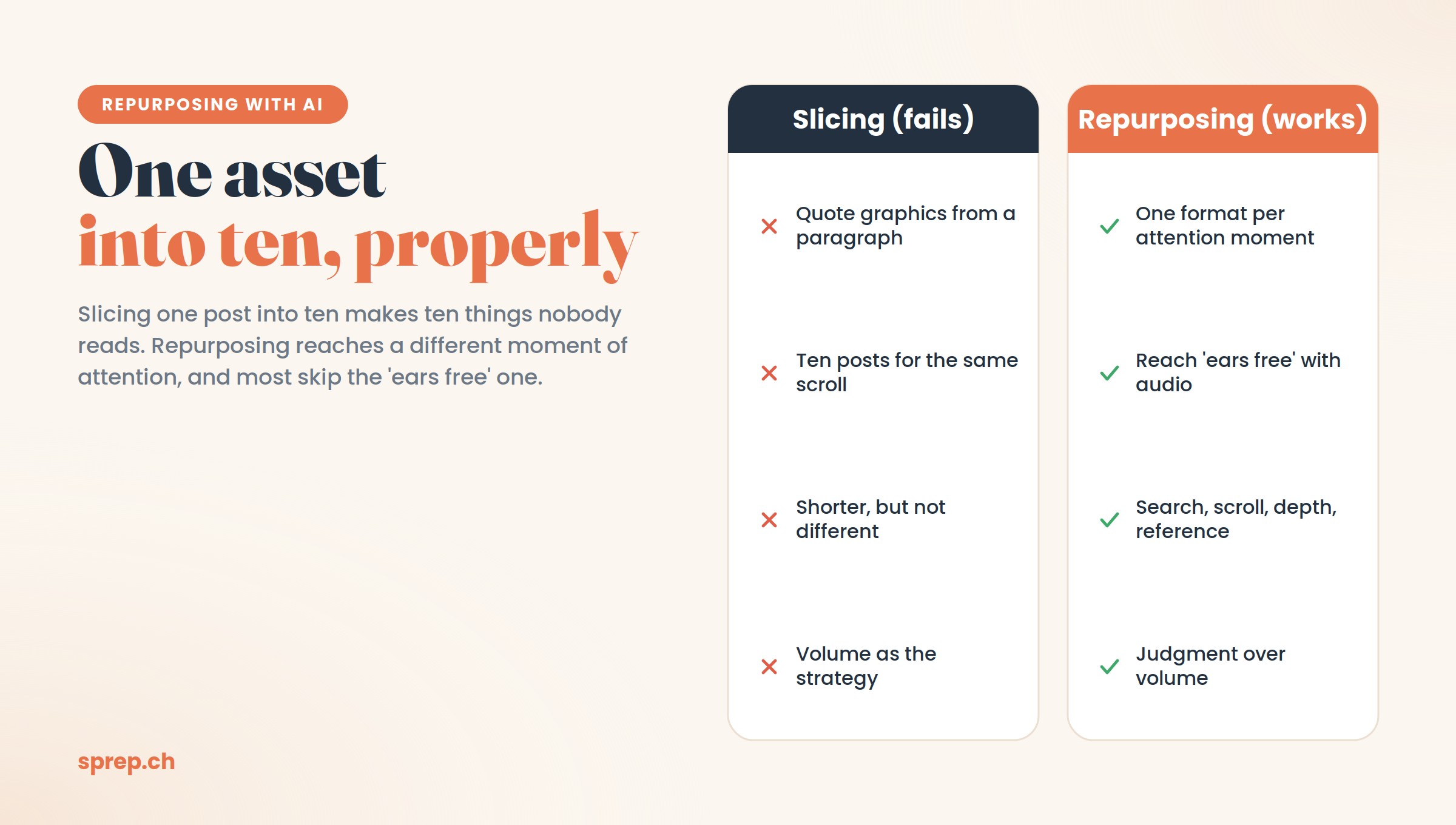
Here is what normally happens. You write a 2,000-word blog post. You pull five quotes and make five graphics. You cut three sections into LinkedIn posts. You turn the intro into a tweet. Ten assets, one afternoon, feels productive.
Then all ten underperform, and the conclusion you draw is that your audience is small or the algorithm hates you.
The actual problem is that you did not repurpose anything. You sliced. All ten pieces still serve the same job for the same person at the same moment. They are shorter, but shorter is not different. A quote graphic pulled from a paragraph is that paragraph with a border around it, and the person who would have read the paragraph is the same person scrolling past the graphic.
Repurposing works when the new format reaches a moment the original could not. It fails when it reaches the same moment in a smaller package.
The only test that matters#
Before making any version of anything, ask one question: What moment does this format reach that the original does not?
Not what platform. What moment? Platforms are a proxy for moments and a bad one, because the same person uses four platforms in four different states of attention.
The moments worth designing for:
Deliberate search. Somebody has a problem and typed it into Google. They have intent, patience, and both hands. Long-form written content owns this. Nothing else comes close.
Idle scroll. Somebody is on a train, tired, thumb moving, with no goal. They will give you two seconds before deciding. Short video and strong single images own this.
Hands busy, ears free. Commuting, driving, walking the dog, at the gym, doing dishes, folding laundry. This is a genuinely large block of time and the vast majority of creators publish nothing into it because publishing into it requires audio.
Deliberate depth. Somebody has already decided you are worth their time and wants the full argument. Newsletters, long videos, and podcasts own this.
Reference. Somebody needs to check a specific thing. Written, searchable, skimmable.
Ten pieces that all serve idle scroll is a slicing strategy. Four pieces that serve four different moments is a repurposing strategy, and it will beat the ten.
One asset into ten, done properly#
Say you published a 2,500-word guide. Here is a version that actually earns ten pieces, with the moment each one serves.
- The original long-form post. Deliberate search. This stays the canonical version and everything else points back to it.
- A podcast episode of the same material, restructured for listening. Hands busy. This is the single biggest reach expansion available, because it is a moment you currently publish nothing into.
- A newsletter edition with the core argument and one thing you did not put in the post. Deliberate depth, for people who already opted in.
- A short video on the single most counterintuitive claim. Idle scroll. One idea, not a summary.
- A second short video on the most practical tip. Idle scroll, different hook, same asset.
- A carousel walking through the framework step by step. Between scroll and depth, for people who stopped scrolling but will not click.
- A text post arguing the one thing you believe that most people in your field do not. Idle scroll with a comment hook.
- A comparison table or checklist as a standalone image. Reference. This is the piece people save and come back to.
- A reply-format post answering the most common objection to your argument. Deliberate search, long tail, catches a different query than the original.
- A short audio clip of the strongest two minutes, for social feeds where audio autoplays and for anyone sampling before committing to the full episode.
Notice that only three of those are recognizably "the blog post, but shorter." The rest are different arguments, different depths, or different senses entirely.
Notice also that the audio pieces are two of the ten, and most creators produce zero of them. The cheapest place to find that second audio piece is content you already published, which we cover in repurpose blog posts into audio in minutes.
Is repurposing content legal?#
This comes up constantly and almost no guide addresses it, so here it is directly. General information, not legal advice, and worth checking with a lawyer for anything consequential.
Repurposing your own content is completely fine. If you made it, you own the copyright automatically from the moment it was created and fixed in some form. No registration required for that protection to exist. You can chop, re-edit, republish, translate, and re-release your own work as many times as you like. Nobody can stop you, and you owe nobody credit.
Repurposing someone else's content is a different question entirely. Reposting another creator's photo, video, or writing without permission is potential infringement even if you credit them. Attribution is not permission. Those are separate things, and confusing them is the single most common mistake creators make.
A few specifics worth knowing:
- "It was on the internet" does not mean public domain. Almost all creative content is automatically protected the moment it is made, with no copyright symbol or registration needed.
- Copyright protects expression, not facts or ideas. You can absolutely make content about the same idea, or state the same fact, as long as you write it in your own words rather than copying theirs. This is what makes covering a trending topic legal and copying someone's video script not.
- Fair use is a defense, not a permission slip. It is judged on four factors, including how much you used and whether your use damages the original's market. Outcomes are fact-specific and hard to predict, so treating it as a reliable shield is risky.
- Memes and clips carry the same rules. A still from a film or a widely circulating meme is still copyrighted, and using it in a commercial or branded post can be infringement regardless of how many other people are using it.
- The realistic consequence is usually a DMCA takedown rather than a lawsuit, but repeat infringement can cost you the account, which for a creator is the actual disaster.
The short version: repurpose your own work freely, get permission for anyone else's, and remember that credit is not consent.
Does repurposing hurt your SEO?#
Mostly no, with one thing to get right.
There is no general "duplicate content penalty" in the sense creators usually fear. Google is not going to punish your site because your newsletter and your blog post say similar things.
What can happen is dilution. If the same substantial content lives at multiple URLs you control, search engines have to pick which one to rank, and they may not pick the one you wanted. The fix is straightforward: decide which version is canonical, keep it on your own site, and when you republish elsewhere, either point the canonical tag back to your original or make the off-site version genuinely different in angle and substance rather than a copy.
Repurposing across formats, blog to audio, blog to video, blog to social, raises no duplicate content issue at all. Those are different media, not competing pages.
Where AI actually helps, and where it makes things worse#
AI made repurposing nearly free, and that changed the economics in a way worth being honest about.
What AI is genuinely good at: format translation. Restructuring an argument for a different length, a different medium, or a different reading level. Producing a first draft of a script from a written piece. Generating the mechanical variants, alt text, chapter markers, summaries that used to eat an afternoon. Translating into other languages.
What AI is bad at: having a point of view. Knowing which of your ideas is the interesting one. Deciding what to leave out. Judging whether a claim is actually true. Every one of those is the part that determines whether the piece works.
And the strategic consequence people miss: when everyone can produce ten pieces from one, volume stops being a differentiator. It is now table stakes and slightly negative, because the feed is fuller and attention did not grow. What survives that is judgment, specificity, and an actual position, none of which AI supplies.What that leaves as a growth strategy is covered in how to grow a podcast audience without ads.
So use AI to make the versions, not to decide what is worth making. And read everything before it goes out, because AI-generated variants are confidently fluent about details they got wrong, and your name is on it.
The format most creators skip#
Go back to the moments list. Almost every creator publishes into deliberate search, idle scroll, and deliberate depth. Almost none publish into hands busy, ears free.
That is a substantial and uncontested block of attention: commutes, workouts, chores, walks. It is time when your audience genuinely cannot read anything, so the competition for it is a fraction of what it is in the feed.
The reason so few creators use it is production cost. Recording, editing, and publishing audio used to be a real project, and the ROI was unclear when you already had a backlog. That calculation has changed. If you have never recorded anything, our guide on how to start a podcast with no equipment covers doing it with a phone and no purchases.
One honest caveat, since this whole guide is about format fit: audio is not automatically better. Long documents get abandoned far more often than podcast episodes get abandoned, which is the argument for it, and we cover the underlying dynamic in the unread problem. But audio is bad for anything people need to reference precisely, anything visual, and anything with figures they will want to check. Use it for arguments, stories, and explanation.If you already publish a newsletter, that is the fastest starting point: we have platform-by-platform mechanics in how to turn your newsletter into a podcast, and a Substack-specific version in Substack to podcast.
Where Sprep fits#
We make a document-to-podcast tool, so treat this as an interested party talking.
Sprep turns things you have already written- blog posts, newsletters, Substack pieces, PDFs, and slide decks- into two-host conversational podcast episodes rather than single-voice narration of your text. The distinction matters: reading your blog post aloud produces something with all the structural problems of a blog post plus a slower delivery. Restructuring it as a conversation is what makes it work as audio.
A person reviews and edits the script before any audio is generated, which is included on the free plan. That step exists because fully automated generation sounds polished and gets details subtly wrong, and for a creator, publishing something confidently incorrect under your own name is a higher cost than the time saved.
The free plan converts one document into a full episode of up to 15 minutes, which is enough to test whether the format does anything for your audience before you commit to it.
Where it is the wrong tool: if the appeal of your podcast is hearing your actual voice and personality, record yourself. If you want interview-driven shows, you need real interviews. And it will not save a piece that was not good in writing, since the conversion is faithful to what you gave it.
FAQ#
What is content repurposing? Content repurposing means adapting something you already published into a different format for a different audience, platform, or moment of attention. A blog post becomes a podcast episode, a video becomes a carousel, a newsletter becomes a short video. The goal is reaching people the original could not reach, rather than simply producing more pieces.
Is repurposing content illegal? Repurposing your own content is entirely legal, since you own the copyright automatically from the moment you create it. Repurposing someone else's content without permission can be infringement, even if you credit them, because attribution is not the same as permission. This is general information rather than legal advice.
Can you get sued for reposting someone else's content? It is possible, though the more common outcome is a DMCA takedown notice and removal of the post. Repeated infringement can result in losing your account, which for most creators is the more serious consequence. Fair use is a defense rather than a permission, is judged case by case, and is unreliable to depend on.
Does repurposing content hurt your SEO? Not in the way most people fear. There is no general duplicate content penalty. The real risk is dilution when substantially identical content sits at multiple URLs you control, which you fix with canonical tags pointing to your preferred version. Repurposing across different formats such as text to audio raises no duplicate content issue at all.
How many pieces should you make from one asset? Fewer than the advice usually suggests, and chosen by moment rather than by count. Ten pieces that all serve the same scrolling audience will underperform four pieces that serve search, scroll, listening, and depth separately. Ask what moment each version reaches that the original could not.
What is the difference between repurposing and slicing content? Slicing means cutting the original into smaller pieces that still serve the same audience in the same context, such as pulling quote graphics from a blog post. Repurposing means changing the format so it reaches a different moment, such as turning that post into audio for people who cannot read while commuting.
What content should you repurpose first? Start with whatever already performed well, since audience response is better evidence than your own judgment about what deserves a second life. Evergreen material beats time-sensitive material, because a repurposed piece published three months later still works.
Can AI do content repurposing for you? AI handles format translation well: restructuring for length, drafting scripts, generating summaries, and translating languages. It does poorly at judgment, deciding which idea is interesting, what to cut, and whether a claim is true. Use it to produce versions, not to decide what is worth producing, and review everything before publishing.
Which formats do most creators miss? Audio, by a wide margin. Most creators publish for search, for scrolling, and for their committed audience, but publish nothing for the time people spend commuting, exercising, or doing chores. That block of attention is large and comparatively uncontested precisely because producing it used to be expensive.
How often can you republish the same idea? More often than most people are comfortable with. A small fraction of your audience sees any individual post, and formats reach different people entirely. The practical limit is whether each version stands on its own rather than reading as a recycled fragment of something else.
Turn one post into an episode#
If the listening moment is the gap in your publishing, the free plan turns one thing you have already written into a full podcast episode of up to 15 minutes, with the script editor included so you can fix every word before any audio is generated.
See it in action